Winter Failures Cost a Whole Commute
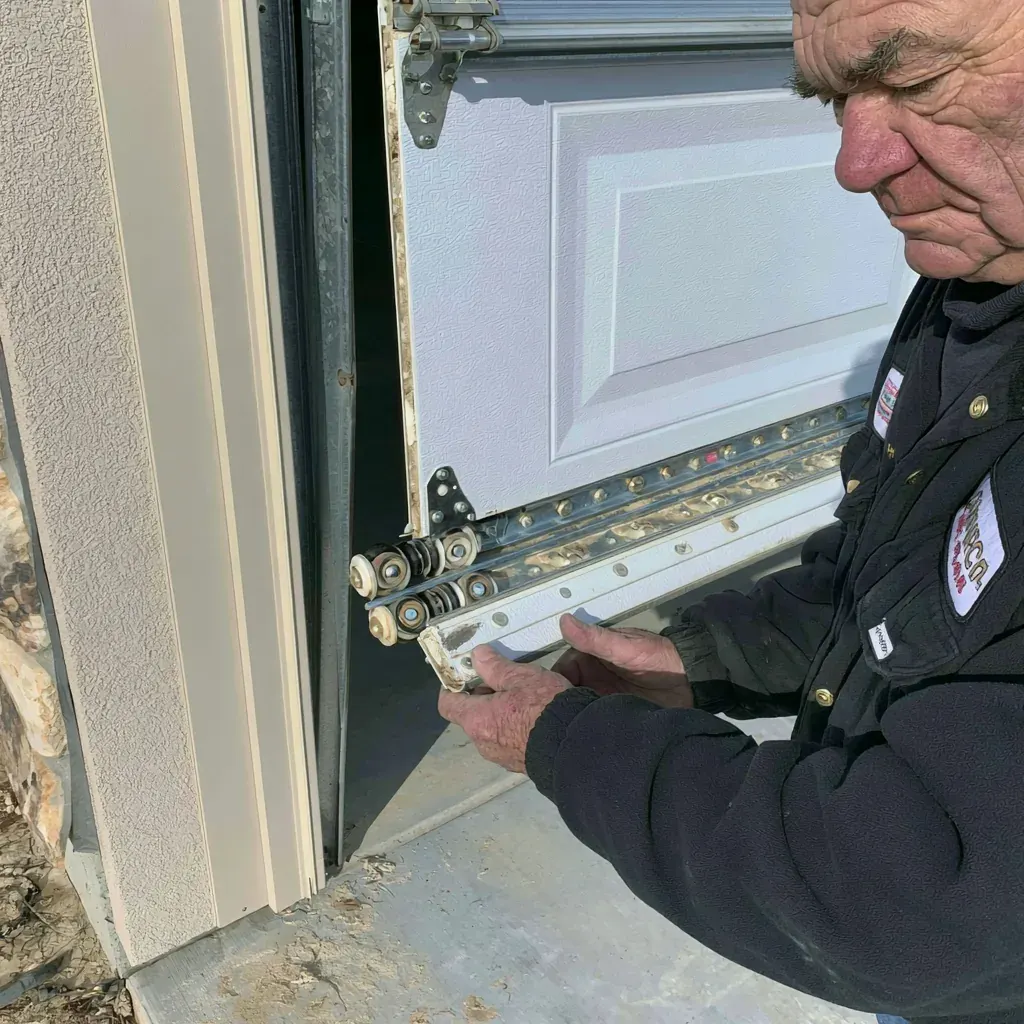
Fishers winters push brine and salt off roads like 96th Street and Olio Road straight into garages on tires, where it dries hard against the lowest inches of track and gives a roller a fixed spot to fight every cycle.
Track brackets bolted to the jamb near 116th Street and Allisonville Road garages loosen a fraction with every winter freeze-thaw cycle, and dust tracked in off Fishers driveways packs into the rail groove, so the rollers catch on the same buildup or the same loose bracket each time.
Winter changes what a spring is made of, mechanically speaking. Torsion steel that flexes fine in July turns brittle once temperatures drop hard, and the snap tends to happen on the coldest push of the season, first thing in the morning.
When a Door Bonds to the Slab
- Pattern
- Sticks or shudders at one fixed point on every cycle, pointing to a bracket, a flange, or grit rather than a bent rail.
- Cause
- Dried road salt residue in the bottom track, a loosened bracket, or a jamb edging out of square.
- Risk
- Worsens through cold weeks as grease thickens; rarely clears up without attention.
- First Check
- Roller and rail at the catch point first, then bracket fastening and jamb alignment behind it.
- Left Alone
- A roller jumping the rail entirely, or a panel splitting at the stile, if the opener keeps forcing through the same bind point.
- Active Period
- Salt brine tracked in on tires through a Fishers winter builds up at the same low point in the track, thickening with cold grease. Binding usually shows up gradually across the coldest months rather than after one storm.
- Guide Price
- an estimated $159–$649
What a Stuck Slab Bond Feels Like
Binding gets confused with a sagging door section because both make the door look uneven mid-cycle. A sagging section droops along its whole width even when still. Binding holds the door square everywhere except one fixed catch point where it hangs up every time. Watch the door through one full cycle. If it stalls or shudders at the identical spot each time, that is binding. If one panel edge looks low or twisted the entire way up and down, the section itself has sagged, a separate repair.
What a Fishers Winter Does to Springs
The licensed pros we connect you with go straight to the point the door catches, checking the track bracket screws against the jamb, wiping the rail for packed grit, and sighting the rail for a flange pulled slightly inward. Most binds trace to one of those three, not a bent rail.
They also run the door through a full cycle to see if it reverses before it closes right at that spot, since a misreading safety sensor can mimic a mechanical bind and needs ruling out before any bracket work begins.
An opener drawing harder than usual to lift the same door is often reporting on the rollers, not itself. Grease that has thickened in the cold adds resistance the motor was never sized for, and a gear stripped from that strain costs more than the grease would have.
BOTTOM BRACKET MATERIAL AND HOW FAST FLOOR-LEVEL RUST SETS IN
| What You'll Notice |
Why It Failed |
|---|
| A slow-closing door in January usually isn't the opener giving up. Cold grease stops flowing the way it should, rollers drag against thickened lubricant, and the motor pulls harder current to move the same weight. That extra strain is what wears out gears and capacitors well ahead of schedule. | Freeze and thaw cycles work a different kind of grit into rollers and hinges than dust ever could. Meltwater carries road salt off the slab into the track, then refreezes overnight and locks grit against the metal. Sealed bearings and heavier-gauge hardware shrug off that abrasion instead of wearing thin from it. |
| Meltwater running off the roof in the afternoon has nowhere to go but the slab, and it sits there until the temperature drops again overnight, gluing the weight of the door to the concrete before the first cycle of the day. | A garage door built for one climate keeps behaving that way even after decades of freeze and thaw. Steel spring wire stiffens and cracks, seals lose their grip on cold slab concrete, and lubricant thickens until rollers drag instead of turning. Panel skins and hardware near the floor take the slowest, quietest damage of all. |
| Steel spring wire loses give as it gets cold, so the same lift that was routine in July can snap coils outright once temperatures drop hard. Add a winter's worth of stiff, unresponsive grease in the rollers and an aging spring is carrying load it was never rated for. | Grease that lubricates fine in July can turn sluggish once temperatures drop, and rollers start dragging against tracks that used to move quietly. The opener compensates by pulling more current to lift the same weight, and that extra strain is usually the first sign something upstream needs attention. |
The Part That Fails First In Winter
Look for the door catching at the same point on every pass rather than dragging unevenly the whole way. Wipe the bottom track clear of dried salt residue and check by hand whether the nearby bracket has any play against the jamb.
Reading What Road Salt Left Behind This Season
The door hangs up at one exact spot on every cycle, then shudders as the opener keeps pulling against it. Around Fishers that spot is usually where grit off Allisonville Road has packed into the track, a bracket has worked loose, or the roller has started riding the flange edge instead of the channel.
Still waiting on that door to move?
Most door binding in the tracks jobs in Fishers land between an estimated $159 and $649, and the property decides where inside that. What is priced here is the hardware and the labor to fit it: springs, cables, rollers, hinges, the bottom seal, opener parts and panel repair. Damage to the building itself is quoted separately once somebody has actually looked at it, whether that is a jamb softened by years of meltwater or a slab edge spalled under the threshold. Find out the visit charge up front, and ask for the scope in writing. Full bands and what moves them are on the pricing guide, and the service that handles this is Off-Track Garage Door Repair.