A Fishers homeowner pulling into the driveway on a January morning notices cold air sliding under the garage door and pooling around their ankles, or daylight showing along the bottom edge where none showed last winter. The instinct is to blame the opener or the insulation, but most of the time the actual failure is smaller than that: a length of rubber or vinyl that has stopped doing its one job, which is closing a gap. Knowing which piece failed changes what it costs to put right.
Start With the Bottom Seal
The bottom seal is the rubber strip that runs the width of the door, held in a channel along the bottom bracket. It is the piece under the most stress, since it compresses against the slab every time the door closes and has to flex back out again on the way up. In Fishers, that same seal is what road salt and de-icing brine track in on tires reach first, working on it from the floor up rather than from any weather above.
What Failure Looks Like
A failed bottom seal usually shows itself in one of three ways: it has pulled loose from the bracket at one or both corners, it has gone rigid and cracked instead of folding flat when the door closes, or it has flattened out on one side so it no longer meets the slab evenly. Any of those leaves a gap a draft can move through, and on a flat driveway around Fishers that gap is often exactly where meltwater sits overnight.
Astragal Is Not the Same Part
On a double-wide door, the astragal is the wider vinyl strip mounted where the two door panels meet in the middle, closing that seam the way the bottom seal closes the floor gap. It gets confused with the bottom seal because both are rubber-and-vinyl and both fail from flexing, but they are separate parts, sold and replaced separately, and a homeowner near Cumberland Road can have one fail without the other showing any wear at all.
The Stop Molding's Job
Stop molding is the narrow strip nailed along the door frame's sides and header, closing the gap between the door face and the jamb. In Fishers it takes a beating from the seasonal swing between a January hard freeze and a humid July, which loosens fasteners and opens hairline splits. Once it splits, you get a visible line of daylight at the frame near Cumberland Road subdivisions with older doors, and cold air pushes straight through into the garage.
Why the Threshold Matters
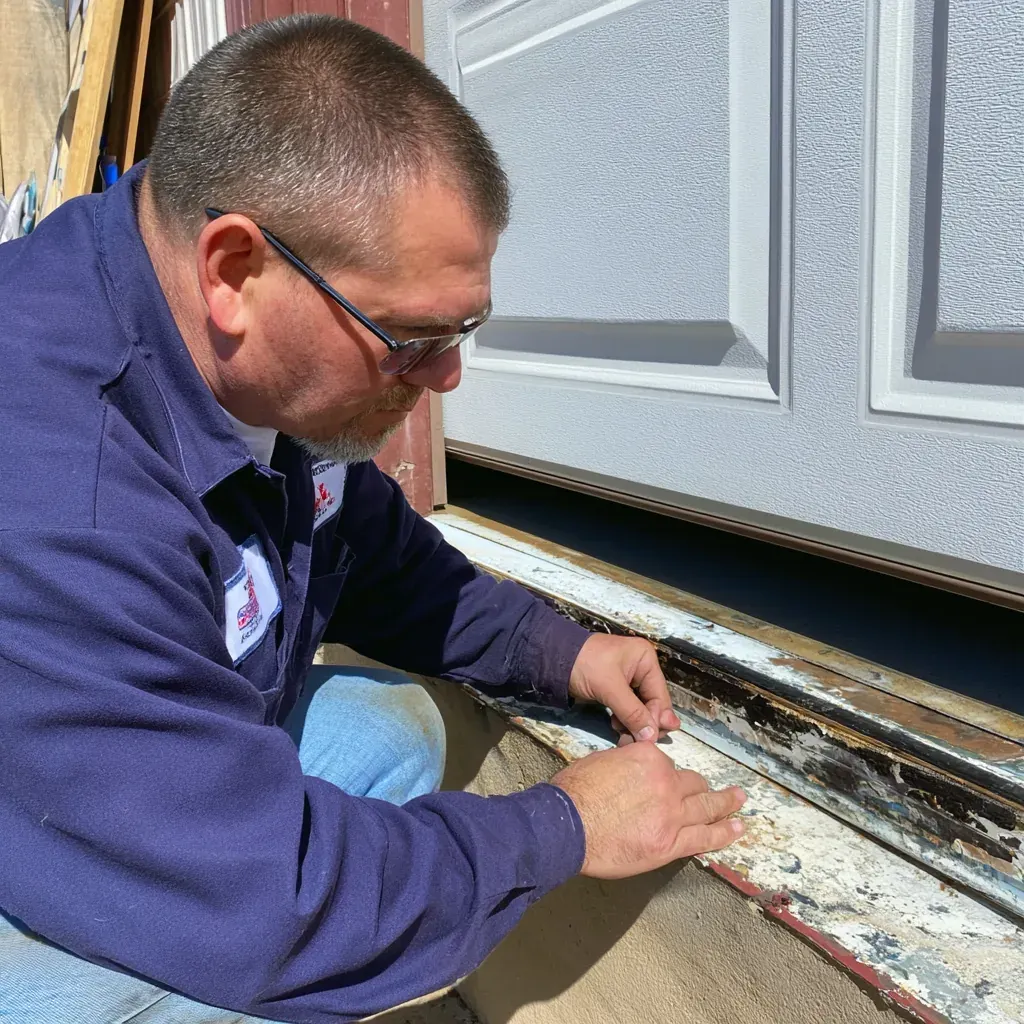
Not every Fishers garage has a true threshold, but where the slab meets the driveway, a raised strip or bead of sealant is doing the job of closing that gap. The bottom seal presses against it to keep meltwater and driveway runoff out. Because so much Fishers grading slopes the driveway toward the garage rather than away, that threshold is doing more work here than it would on a lot that drains properly, and it wears from the water side first.
How Salt Speeds This Up
Fishers plow crews and neighbors alike lay down road salt through most of winter, and that brine rides in on tires and boots long after the storm has passed. It pools at the base of the door, dries, and reforms as a crust that grinds against the bottom seal every time the door cycles. A seal that might last several winters on a garage set back from the street can crack a season sooner on a driveway off Allisonville Road or 116th Street, where salt traffic is heavier.
Freezing to the Slab
Hamilton County winters bring real hard freezes, not the occasional dip. When meltwater sits at the threshold from a driveway that drains the wrong way and the temperature drops overnight, that water can bond the bottom seal to the slab itself. The door looks stuck shut, but the spring and opener are fine. What has happened is the rubber has frozen flat against the concrete, and forcing the opener against that bond is what actually tears the seal.
What Each Fix Runs
A bottom seal is generally the least expensive of these to replace, since it is a length of rubber sliding into an existing bracket track. Astragal replacement costs more because the strip is wider and sometimes fitted with a retainer, and stop molding runs higher again since it is cut to length and fastened along the frame rather than just slid into a channel. A threshold repair varies most, since it depends on what the slab underneath is doing.
When It Is Not Worth Replacing
Not every draft means the seal needs replacing. A bottom seal that has worked loose from its retainer track, or stop molding pulled away from the jamb after the door was forced against ice, can often be reset without buying new material. Check whether the seal is torn, flattened, or missing chunks along its length before assuming it is done. If it still has its shape and just slipped its track, that is a five-minute fix, not a parts order.
Covenant Approval First
Fishers neighborhoods are covenant-controlled to a degree that catches people off guard, and in some of them even trim and seal color can need sign-off before a replacement gets ordered. That is a real lead-time factor near communities like Geist Overlook or Bridgewater, not a formality, so it is worth checking with the association before assuming a new seal or molding can go in on the first visit.
Getting the Right Part
Telling a bottom seal from an astragal, stop molding, or a worn threshold by feel in the dark isn't easy, and guessing wrong means buying the wrong part twice. A homeowner near Geist or along Allisonville Road can describe what they're seeing, but a short look at the actual opening settles which piece failed. That inspection costs nothing, and it's the fastest way to know whether the fix is a strip of rubber or something at the threshold itself.
Dealing with this in your home?
Fishers garages sit on slabs that go through the same freeze and thaw all winter, and meltwater from a sunny afternoon on Cumberland Road or 116th Street refreezes overnight into a bond between door and concrete. Force it and the bottom seal tears. Road salt tracked in off I-69 does the rest, working the bottom brackets and rollers from the floor up.