This question usually starts with a contractor standing in a Fishers driveway saying the ceiling won't clear a normal opener. It happens on garages finished for extra storage, or older ones near the Nickel Plate District built before a rail-and-trolley opener was assumed. The homeowner isn't shopping yet. They're trying to figure out what a jackshaft opener even is, and whether their garage actually needs one before they call anybody.
What A Jackshaft Opener Is
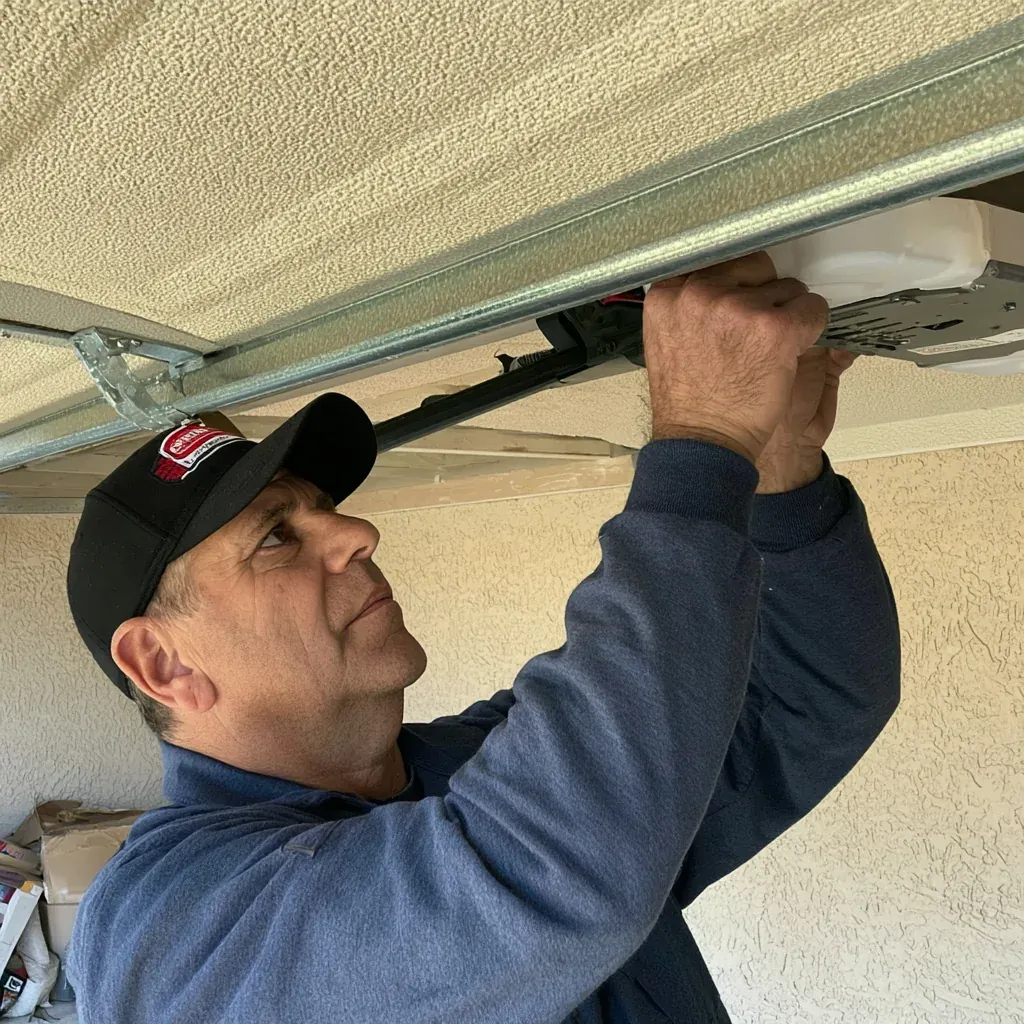
A standard opener bolts to the ceiling and pulls the door along a rail with a chain or belt. A jackshaft opener skips the rail entirely. It mounts to the wall beside the door and couples directly to the torsion shaft that already runs above the opening, turning that shaft to raise the door instead of pulling it. No rail means no ceiling clearance requirement, which is the whole reason it exists.
Why Headroom Forces The Choice
Ceiling-mount openers need room above the door for the rail to swing up as the door opens, plus space for the mounting bracket. Some Fishers garages fall short of that, particularly older ones near the Nickel Plate District where a finished ceiling or a low header eats the clearance a standard opener wants. A jackshaft opener sidesteps the problem entirely by mounting to the wall beside the door and driving the torsion shaft directly, with no rail overhead at all.
What High-Lift Track Changes
High-lift track raises the door further before it curves flat under the ceiling, which frees up headroom below rather than above. It's the fix when someone wants a car lift, extra shelving, or storage racks along the ceiling and a standard curve puts the door too low to clear them. It's a track and hardware change, not just an opener swap, and it usually gets specified alongside a jackshaft conversion rather than instead of one.
How A Conversion Actually Works
A conversion pulls the ceiling-mounted rail out of the garage entirely, along with the bracket that carried it, so nothing crosses the ceiling above the door anymore. In its place, the jackshaft operator mounts on the wall beside the torsion shaft, right where the shaft's end bearing sits, and drives that shaft directly by its end rather than pushing a chain or belt along a track. Homeowners around Fishers often ask for this when a car, a lift, or overhead storage in the garage needs the ceiling clear.
Torsion Shaft Condition Matters First
A jackshaft opener works by gripping the torsion shaft itself and turning it, so any flaw in that shaft shows up immediately in how the door moves. A shaft that has sagged in the middle, rusted where the end bearing plate sits, or picked up a bend from years of use will not spin true once the opener is grabbing it directly. Before quoting a conversion, the licensed pros we connect you with check that shaft for straightness and wear, because a jackshaft installed on a bad shaft just repeats the same rough movement, only now driven by a motor instead of a hand pulling a rope.
Where This Shows Up In Fishers
This question comes up most in finished garages around Sunblest and Sweet Briar, and in the deeper garages near Geist Reservoir where boat and trailer storage pushed the ceiling design lower to begin with. It also turns up in older sections near Municipal Drive built before finished-ceiling storage was a common ask, where the framing simply never left room for a standard rail.
What A Conversion Costs
What the job costs depends on how much else has to change along with it. Replacing a ceiling opener with a jackshaft unit on a door that is otherwise standard is the straightforward version. Adding high-lift track, new rollers, or reworking the header bracket because the door in this Fishers house never had the clearance for high-lift in the first place adds labor and parts on top of the base swap.
Weight And Balance After The Swap
Switching to a jackshaft opener does not change how much the door weighs or how hard the springs have to work to hold it. If the torsion springs were sized wrong for the door before the conversion, they still are afterward, and a Fishers homeowner who has one giving out on a January morning near Geist Reservoir will find the new opener straining against the same imbalance the old one fought.
Battery Backup On A Wall Unit
A wall-mount jackshaft can carry battery backup just like a ceiling opener does, and it is worth asking about here because winter storms across Hamilton County knock out power along with everything else. The backup sits inside the same housing bolted beside the torsion shaft, not overhead, so a technician can service it standing on the garage floor instead of a ladder. On a hard-freeze morning when a brittle spring has already let go, having the door still open on battery power matters more than the wall placement itself.
New Wiring Is Electrician's Work
A jackshaft opener mounts somewhere a ceiling unit never needed power, which sometimes means the existing outlet doesn't reach the new wall location at all. Running new circuit wiring to that spot is electrical work, not garage door work, and it's worth asking the person doing the conversion whether that's included or whether it needs a separate call to an electrician before installation day.
What To Ask Before The Conversion
A jackshaft conversion is worth asking about in Fishers when the garage ceiling is finished, when storage or high-lift track leaves no room for a rail, or when the header above the door is too shallow for a standard trolley unit. Homes with vaulted family rooms over the garage, common in newer sections toward 116th Street, run into this more often than older ranch-style layouts do.
Dealing with this in your home?
Fishers garages sit on slabs that go through the same freeze and thaw all winter, and meltwater from a sunny afternoon on Cumberland Road or 116th Street refreezes overnight into a bond between door and concrete. Force it and the bottom seal tears. Road salt tracked in off I-69 does the rest, working the bottom brackets and rollers from the floor up.