Extension Springs and Safety Cables in Fishers, IN
How stretch springs and safety cables lift older Fishers garage doors, and when conversion makes sense.
Extension springs mount above the horizontal track and lift by stretching, not twisting on a shaft. They still show up on older single-car doors around Fishers, particularly near the Nickel Plate District, and each one needs a safety cable threaded through its coils.
How the Stretch Spring Lifts
An extension spring sits above each track rail and lifts the door by stretching under load, then relaxing as the door closes, unlike a shaft-mounted spring that twists. A pulley at the rear guides the cable, and an S-hook links spring to track hanger. Fishers still has a run of these on garages built before headroom over the opening became standard, mostly on smaller single-bay doors around the older parts of the Nickel Plate District. The stretch itself is the point: if the coil ever lets go, nothing holds it to the rail unless a cable runs through it.
Each spring anchors at the rear of the track to a stationary hook or angle iron, then runs forward to a pulley wheel bolted near the front. A lift cable loops around that pulley and connects down to the bottom bracket on the door itself. Because the spring stretches instead of storing torque in a coil, the pull it delivers changes noticeably from a door barely open to one standing wide, which is why these doors often feel heavier partway up than a torsion door does.
Torsion springs sit on a shaft centered above the opening and barely move when the door travels, since the shaft does the turning. Extension springs do the opposite: the coil itself gets visibly longer and shorter along the track with every cycle. A homeowner in a Sunblest or Ridgefield garage can confirm which system they have just by watching the spring during one open and close.
Why the Safety Cable Matters
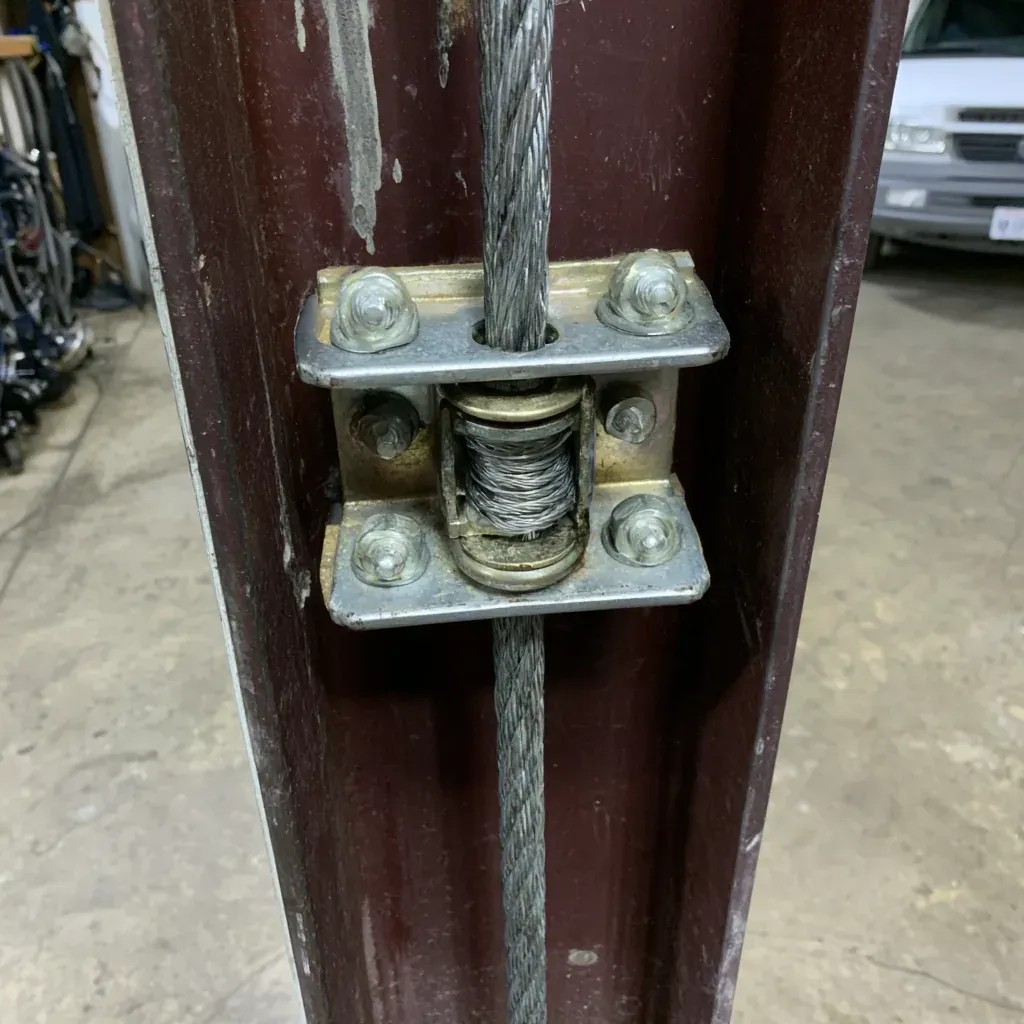
The safety cable is a separate length of cable, thinner than the lift cable, threaded straight through the coils of the extension spring from end to end. It anchors independently at both the front and rear mounting points, not to the spring's own hooks. It carries no load and does nothing while the spring is intact. Its only job is to catch the spring's own weight if a coil snaps under tension, keeping a length of stretched steel from firing across the garage toward a car parked below in a Britton Ridge or Ridgefield driveway.
An extension spring spends its working life stretched close to its rated limit, cycling that way dozens of times a day for years. When the steel finally lets go, whatever energy was stored in that stretch releases immediately, and a bare spring or its S-hook can travel across a garage with enough force to dent drywall or a parked car. The safety cable is what keeps the broken coil contained near the track instead of airborne.
Federal rule has required that cable on residential extension spring systems since the 1970s, so almost every install still in service in Hamilton County already has one, original or added later. What a technician checks for on an older Fishers door is not whether a cable exists but whether it still threads the full length of the coil and both ends are still anchored, since a cable that has slipped free at one end offers no more protection than having none.
Extension vs. Torsion in Use
A torsion spring usually gives some warning before it goes, a slow loss of lift over weeks as the coil fatigues, or a loud bang from a shaft-mounted housing over the opening. Extension springs tend to fail more abruptly at full stretch, right at the point in the cycle where the coil is under the most tension, which in Fishers is often the coldest morning of a hard freeze when the steel has gone brittle overnight.
Extension systems also carry wear points torsion hardware never has to deal with: the pulley wheel and its bracket, and the S-hook connections at each end of the spring. Those parts can bend, stretch, or wear a groove into the pulley track over years of cycling, and any one of them failing looks the same to a homeowner as a spring problem, a door that suddenly hangs unevenly or drops on one side.
Weighing a Torsion Conversion
Converting a Fishers garage from extension to torsion is a legitimate option on many doors, but headroom above the track is what decides whether it is possible at all. A torsion shaft needs several inches of clearance above the opening to mount the springs, cable drums and bearing plates, and older single-car garages near the Nickel Plate District were sometimes framed without that margin because extension hardware never needed it.
Conversion makes the most sense on garages where the ceiling framing leaves little room to spare, since a pulley-and-cable system tucks along the horizontal track rather than demanding open space above the door. Homeowners near the Nickel Plate District weighing the swap should measure that gap first. Fewer parts hanging overhead also means less for road salt and winter grime to reach, though the labor to relocate mounting brackets and rework the track hardware is the real cost of that trade.
Extension Spring Basics
- A torsion spring twists on a shaft mounted above the opening. An extension spring works differently: it is bolted to the back of the horizontal track, stretches as the door closes, and pulls the door open through a pulley and lift cable instead of a rotating shaft.
- Extension springs stretch along the track instead of twisting on a shaft, and they lack the load-bearing shaft a torsion setup has. Cycle life and headroom needs differ from torsion, and a safety cable through the coils is the only thing stopping a snapped spring from becoming a projectile.
- Older single-car garages near the Nickel Plate District, built before torsion shafts became standard, are the ones most likely to still run extension springs and bare steel pulleys.
- Extension springs got chosen originally because the garage lacked the headroom above the opening a torsion shaft and its brackets need.
- A conversion to torsion swaps more than the spring. The drum, the shaft, and often the header bracket layout change with it, which is why the job runs longer than a spring swap alone.
- The S-hook or pulley bracket wears thin from years of the cable riding over it, and that wear point fails on its own, separate from anything happening inside the spring.
Frequently Asked Questions
Why does my garage door have side springs?
Yes, mainly on older single-car garages built before torsion shafts became the standard mount, including some near the Nickel Plate District. Newer construction along the I-69 corridor from the 1990s onward was built with the headroom torsion needs, so extension systems there are the exception rather than the rule.
What's the cable running through my spring for?
That's the safety cable, threaded straight through the coil and fastened at each end to the track hanger, separate from the spring's own mounting. Under normal lifting it does nothing. If a stretched spring snaps, that cable is what keeps the broken ends and hardware from firing across the garage. On a Fishers door old enough to still run extension springs, check that a cable is present on both sides before you trust the door at all.
Can I switch my extension springs to torsion?
Stand under the door and look at where each spring is mounted along the horizontal track. A converted door has no exposed stretched spring at all, just a shaft with two torsion springs sitting above the opening. An unconverted extension setup still has a spring on each side of the track, and if there is no thin cable visible running the length of it, that door has no safety cable installed.
Want your springs looked at?
Extension springs without a safety cable, or old enough to worry about, are worth a look. Ask the licensed pros we connect you with about a torsion conversion.
Call (317) 740-1539